




Case Report - Year 2026 - Volume 41Issue 1
Bilateral Superior Gluteal Artery Perforator (SGAP) Flaps for Total Gluteal Reconstruction After Extensive Hidradenitis Suppurativa
Retalhos perfurantes bilaterais da artéria glútea superior (AGS) para reconstrução glútea total após hidradenite supurativa extensa
Sukru Kasap1, ; Muhammed Said Aydin1; Gokay Ozler1; Mustafa Nisanci1; Onur Ozvurmaz1
ABSTRACT
Hidradenitis suppurativa (HS) is a chronic, recurrent inflammatory disease affecting apocrine gland-bearing areas, often leading to extensive gluteal defects after wide surgical excision. Various surgical approaches exist, including primary closure, secondary intention healing, local flaps, and skin grafting, but no single method serves as the definitive gold standard. Local flaps may be inadequate for large defects, while skin grafts are prone to contracture, potentially compromising functional and esthetic outcomes. Perforator flaps, with long pedicles and wide rotational arcs, provide a reliable alternative, allowing reconstruction of extensive defects without causing contracture, limiting range of motion, or resulting in donor site laxity, while achieving excellent cosmetic outcomes and a short postoperative recovery time. Here,we present the case of a 48-year-oldmalewith an 8-year history of gluteal HS,who underwent wide excision resulting in a defect measuring 32x14 cm. Bilateral superior gluteal artery perforator (SGAP) flapswere used successfully, with the patient returning to social activities early and demonstrating excellent functional and esthetic outcomes at 5-year follow-up. The case presently reported supports perforator flaps as a safe and effective reconstructive option for large gluteal defects in HS.
Keywords: hidradenitis suppurativa; SGAP; perforator flap; gluteal reconstruction
RESUMO
A hidradenite supurativa (HS) é uma doença inflamatória crônica e recorrente que acomete áreas com glândulas apócrinas e, com frequência, provoca extensos defeitos glúteos após a ampla excisão cirúrgica. Há diversas abordagens cirúrgicas, incluindo fechamento primário, cicatrização por segunda intenção, retalhos locais e enxerto de pele, mas nenhum método isolado é um padrão-ouro definitivo. Retalhos locais podem ser inadequados em defeitos extensos, enquanto enxertos de pele são propensos à contratura, com possível comprometimento dos resultados funcionais e estéticos. Retalhos perfurantes, com pedículos longos e amplos arcos de rotação, são uma alternativa confiável, permitindo a reconstrução de defeitos extensos sem causar contratura, limitar a amplitude de movimento ou gerar frouxidão na área doadora; além disso, seus resultados estéticos são excelentes e o tempo de recuperação pós-operatória é curto. Apresentamos aqui o caso de um homem de 48 anos com histórico de HS glútea há 8 anos que foi submetido à excisão ampla, o que levou ao desenvolvimento de um defeito de 32x14 cm. Retalhos perfurantes bilaterais da artéria glútea superior (AGS) foram utilizados com sucesso, permitindo que o paciente retornasse às atividades sociais precocemente e demonstrasse excelentes resultados funcionais e estéticos aos 5 anos de acompanhamento. Este caso corrobora o uso de retalhos perfurantes como uma opção reconstrutiva segura e eficaz para defeitos glúteos extensos decorrentes da HS.
Palavras-chave: hidradenite supurativa; AGS; retalho perfurante; reconstrução glútea
Introduction
Hidradenitis suppurativa (HS), also known as acne inversa, is a chronic, inflammatory, recurrent disease of the hair follicle, primarily affecting apocrine gland-bearing areas. It primarily affects the gluteal, perineal, axillae, and inguinal regions, which are most commonly involved.1 It presents with deep-seated, chronic nodules, sinus tracts, fistulae, and abscesses, which may result in pain, restricted mobility, functional impairment, and significant physical and psychosocial bur-den, thereby leading to a reduced quality of life.2 In the literature, the prevalence of HS has been reported to range between 0.05 and 4.1%, with females being more commonly affected. Hidradenitis suppurativa has a multifactorial etiol-ogy and pathogenesis; consequently, its management is challenging.3 Management strategies for HS encompass both medical and surgical approaches. Medical treatment includes topical and systemic antibiotics, intralesional and systemic corticosteroids, hormonal therapy, and immuno-modulatory agents, while surgical options range from limit-ed lesion deroofing to radical excision of affected tissue.4 Surgical options for HS include incision and drainage for acute abscesses, deroofing of sinus tracts, limited or localized excision of diseased tissue, wide excision of affected areas, and radical excision for extensive disease.5 Reconstruction following surgical excision can be achieved by primary closure, secondary intention healing, and the use of skin flaps, depending on the size and location of the defect.6 The gluteal region is frequently involved in HS, and in advanced cases, excision often results in substantial defects that pose both functional and aesthetic challenges. In these situations, the utilization of perforator flaps provides a reliable and advantageous reconstructive option.
Case Presentation
A 48-year-old male patient presented with an 8-year history of HS, which had significantly exacerbated over the preced-ing 1.5 years. He had previously received combination anti-biotic therapy with rifampicin and clindamycin under the supervision of a dermatologist, without achieving clinical improvement.
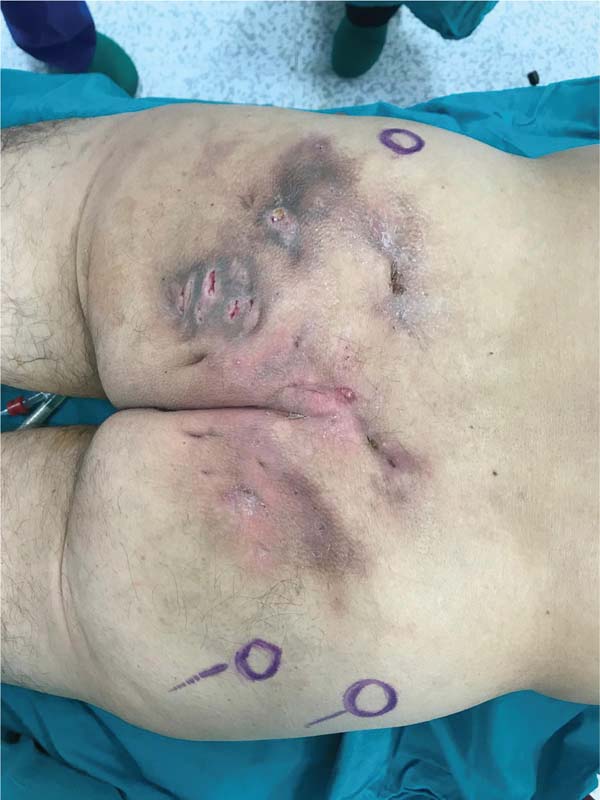
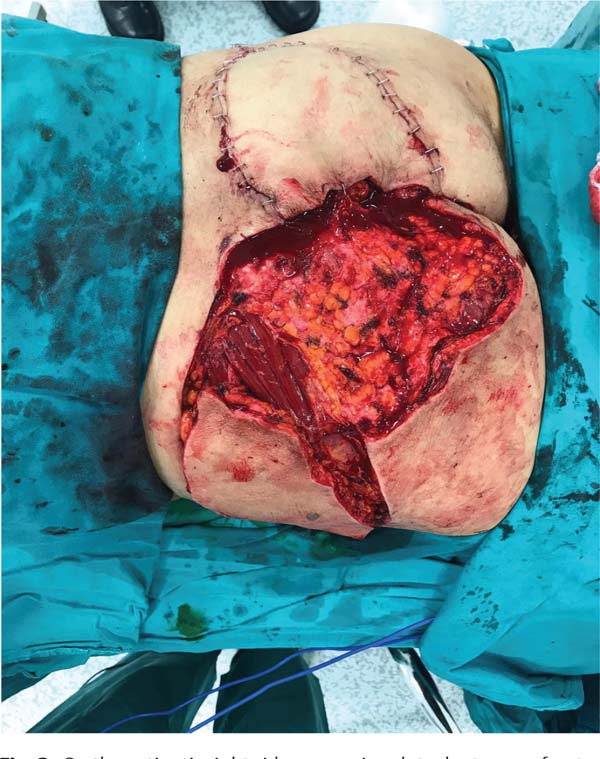
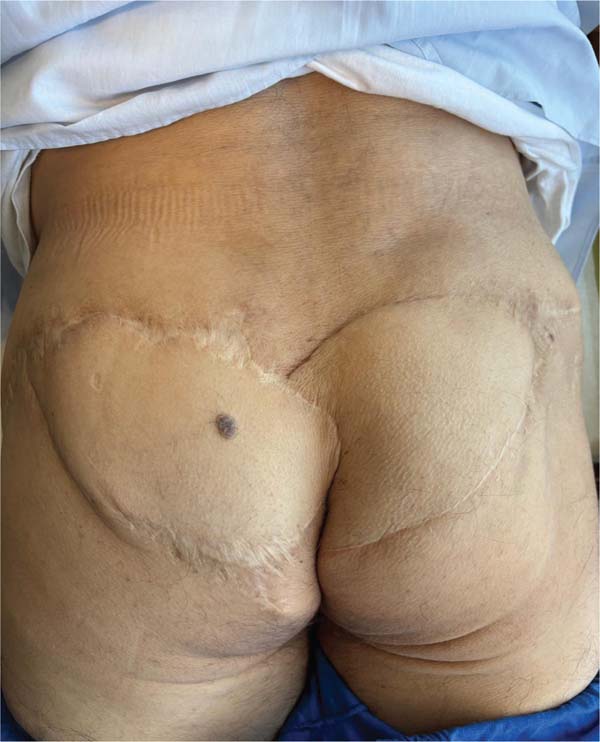
Physical examination revealed extensive lesions involving the bilateral gluteal and sacral regions, characterized by sinus tracts, scattered abscesses, and a malodorous discharge (►Fig. 1). Following wide local excision, the resulting defect measured approximately 32 x 14 cm (►Fig. 2). Reconstruc-tion was performed using bilateral superior gluteal artery perforator (SGAP) flaps, elevated from the subfascial plane. The pedicles were meticulously freed in at least 2 cm from surrounding fascia, and the flaps were transposed to cover the defect without tension or pedicle torsion. Donor sites were closed primarily (►Fig. 3).

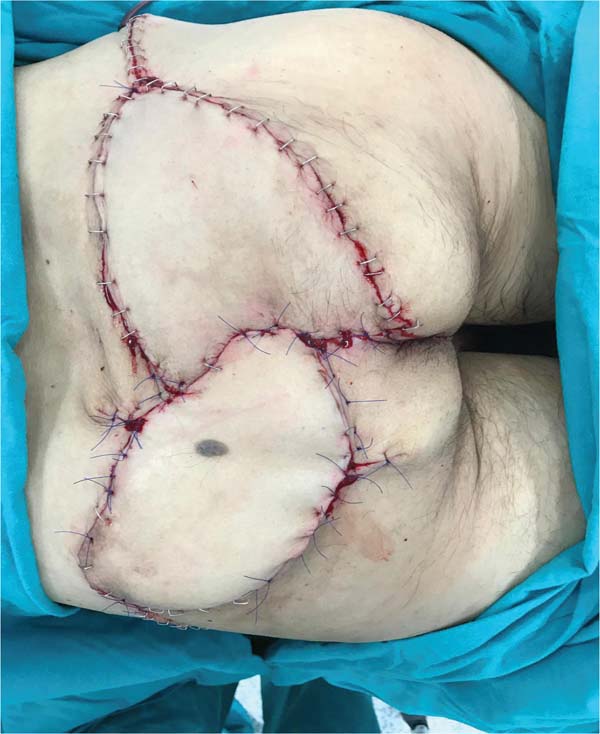
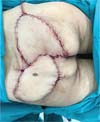
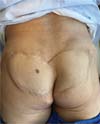
The postoperative course was uneventful, with no compli-cations such as wound dehiscence or venous congestion. Drains were removed on postoperative day 6, and the patient was subsequently discharged. At 5-year follow-up, the pa-tient demonstrated excellent functional and aesthetic out-comes, with no recurrence of hidradenitis suppurativa (►Fig. 4). The flaps remained fully viable, and the patient was able to perform all daily activities without limitation.
Discussion
Multiple surgical techniques have been described for the management of HS; however, no single approach has emerged as the definitive gold standard. According to Gierek et al., local flaps are considered the gold standard for the surgical management of HS; however, they are often inade-quate for covering extensive defects resulting from wide excision.7 Sugio et al. reported that skin grafts can provide superior coverage compared to flaps in some cases; however, they are prone to contracture, which may compromise both functional and esthetic outcomes.8 While primary closure remains the fastest and simplest method for defect coverage. Dietrich et al. demonstrated that perforator-based flaps, such as lateral thoracic artery perforator (LTAP) and thoracodorsal artery perforator (TDAP), can be used for axillary reconstruc-tion in patients with hidradenitis suppurativa without causing contracture, compromising range of motion, or resulting in laxity, while also achieving excellent aesthetic outcomes.9 According to Unal et al. (2011), secondary-intention healing and skin grafting in the gluteal region can prolong patients’ return to daily and social activities and are often time-consuming. Perforator flaps, by contrast, offer long pedicles and a wide rotational arc, making them highly suitable for reconstructing extensive gluteal defects.10 In the surgical management of HS, perforator flaps offer superior cosmetic outcomes, enables a short postoperative recovery time, and can be effectively utilized for the reconstruction of extensive defects, without causing contracture or compromising range of motion.11,12 In our case, an extensive gluteal defect resulting from wide excision for HS was successfully recon-structed using bilateral superior gluteal artery perforator (SGAP) flaps, allowing the patient to return to social activi-ties early and achieving both excellent functional and cos-metic outcomes, thereby supporting the use of perforator flaps as a reliable option for large gluteal defects in similar cases.
Conclusion
Bilateral SGAP flaps provide a reliable and effective recon-structive option for extensive gluteal defects resulting from wide excision of hidradenitis suppurativa. In our case, the use of bilateral SGAP flaps enabled complete defect coverage, preservation of range of motion, avoidance of contracture, and excellent cosmetic outcomes. The patient was able to return to social activities early, demonstrating the functional and aes-thetic advantages of perforator flaps in managing large gluteal HS lesions. The present case supports the broader use of perforator flaps as a safe, versatile, and reproducible tech-nique for extensive gluteal reconstruction in HS.
References
1. Sabat R, Alavi A, Wolk K, et al. Hidradenitis suppurativa. Lancet 2025;405(10476):420-438. Doi: 10.1016/S0140-6736(24)02475-9
2. Goldburg SR, Strober BE, Payette MJ. Hidradenitis suppurativa: Epidemiology, clinical presentation, and pathogenesis. J Am Acad Dermatol 2020;82(05):1045-1058. Doi: 10.1016/j.jaad.2019.08.090
3. McCarthy S. Hidradenitis Suppurativa. Annu Rev Med 2025;76 (01):69-80. Doi: 10.1146/annurev-med-051223-031234
4. Saunte DML, Jemec GBE. Hidradenitis Suppurativa: Advances in Diagnosis and Treatment. JAMA 2017;318(20):2019-2032. Doi: 10.1001/jama.2017.16691
5. Shukla R, Karagaiah P, Patil A, et al. Surgical Treatment in Hidradenitis Suppurativa. J Clin Med 2022;11(09):2311. Doi: 10.3390/jcm11092311
6. Mateu-Arrom L, Puig L, Vilarrasa E. Surgical Approach to Hidra-denitis Suppurativa. Actas Dermosifiliogr 2025;116(06): 621-627. Doi: 10.1016/j.ad.2024.10.061
7. Gierek M, Ochała-Gierek G, Kitala D, Łabuś W, Bergler-Czop B. Surgical management of hidradenitis suppurativa. Postepy Der-matol Alergol 2022;39(06):1015-1020. Doi: 10.5114/ada.2022.115323
8. Sugio Y, Tomita K, Hosokawa K. Reconstruction after Excision of Hidradenitis Suppurativa: Are Skin Grafts Better than Flaps? Plast Reconstr Surg Glob Open 2016;4(11):e1128. Doi: 10.1097/GOX.0000000000001128
9. Dietrich S, Reumuth G, Kuentscher M, Panchulidze I. Die Verwen-dung lokaler Perforatorlappenplastiken der Arteria thoracica lateralis (LTAP) und Arteria thoracodorsalis (TDAP) zur axillären Rekonstruktion bei Hidradenitis suppurativa. Handchir Mikrochir Plast Chir 2021;53(04):370-375. Doi: 10.1055/a-1203-0322
10. Unal C, Yirmibesoglu OA, Ozdemir J, Hasdemir M. Superior and inferior gluteal artery perforator flaps in reconstruction of gluteal and perianal/perineal hidradenitis suppurativa lesions. Microsur-gery 2011;31(07):539-544. Doi: 10.1002/micr.20918
11. Krajewski A, Alsayed A, Capek A, Casey K, Chandawarkar R. Surgical Management of Hidradenitis Suppurativa. Plast Reconstr Surg Glob Open 2024;12(06):e5860. Doi: 10.1097/GOX.0000000000005860
12. Tercedor-Sánchez J, Ródenas-López JM, Ramón-Faba P, Muñoz-Romero F. Parascapular perforating flap to treat severe axillary hidradenitis suppurativa. Actas Dermosifiliogr 2015;106(08): 669-671. Doi: 10.1016/j.ad.2015.05.005
1. Department of Plastic, Reconstructive and Esthetic Surgery, Muğla Sıtkı Koçman
University Faculty of Medicine, Muğla, Turkey
Address for correspondence Şükrü Kasap, Muğla Eğitim ve Araştırma Hastanesi, Kötekli, Marmaris Yolu No:48, 48000 Menteşe/Muğla, Turkey (e-mail: drsukrukasap@gmail.com).
Artigo submetido: 06/11/2025.
Artigo aceito: 16/12/2025.
Editor-in-Chief: Dov Charles Goldenberg.
Conflict of Interests
The authors have no conflict of interests to declare.
 Read in Portuguese
 Read in English
 PDF PT
 Print
Print
 Send this article by email
 How to Cite
 Mendeley
 Pocket
 Facebook
 Twitter