




Original Article - Year 2026 - Volume 41Issue 1
Breast Esthetic Preferences from the Perspective of Medical Students: A Cross-Sectional Study
Preferências estéticas de mama sob a perspectiva de estudantes de medicina: um estudo transversal
Luís Gustavo Ramos Raupp Pereira1, ; Laura Librelotto Rubin Rodrigues1; Maria Eduarda Caldato1; Mateus Eduardo Giovelli1; Karoline Scussel Ruhmke1; Ana Luíza Fontana1; Eduardo Madalosso Zanin1
ABSTRACT
Introduction The lack of objective data in the surgical literature hinders plastic surgeons from guiding patients and selecting the most appropriate technique for cosmetic breast surgery. The present article analyzes breast-related esthetic criteria among medical students from a university in the state of Rio Grande do Sul, Brazil.
Materials and Methods Data collection used a questionnaire sent via email to university students.
Objective To assess the relationship between age and ideal breast esthetics by examining how the university environment influences the definition of breast esthetic standards, and to provide support to surgeons in guiding their patients and selecting the surgical technique.
Results We collected 239 responses. Most participants (61.1%) preferred a 50/50 upper-to-lower pole volumetric ratio. In addition, 59.83% of respondents preferred a central location for the areola and nipple, and 83.68% preferred small-sized areolas and nipples.
Conclusion The
Results showed a preference for symmetrical patterns over pole deviations or angulations. There were no statistically significant differences between genders.
Keywords: surgery, plastic; esthetics; breast implantation; breast; mammaplasty
RESUMO
Introdução Diante da falta de dados objetivos na literatura cirúrgica, existe no meio profissional da cirurgia plástica uma dificuldade quanto à orientação dos pacientes e à escolha da técnica mais adequada para a realização da cirurgia estética de mama. O presente artigo busca compreender os critérios estéticos da mama tendo como base uma amostra de estudantes de medicina de uma universidade gaúcha.
Materiais e Métodos A coleta de dados foi realizada através de um questionário enviado via e-mail aos alunos da universidade.
Objetivo Avaliar a relação entre idade e ideal estético da mama, analisar a influência do ambiente universitário na definiçãodeumpadrãoestéticodemamas e fornecer suporte aos cirurgiões na orientação de seus pacientes, além de auxiliar tais profissio nais na escolha da técnica cirúrgica a ser utilizada.
Resultados Foi coletado um total de 239 respostas. Em relação à diferença proporcional entre o volume dos polos superior e inferior, observamos que 61,1% dos participantes demonstraram preferência pela proporção 50/50. No quesito de diferenças de localização da aréola e do mamilo, evidenciou-se a predileção pela localização central com 59,83%. Em questão do tamanho entre a aréola e o mamilo, percebeu-se que a maior parcela dos participantes da pesquisa, 83,68%, demonstraram preferência pelo tamanho pequeno da aréola e mamilo.
Conclusão Os resultados demonstraram uma preferência aos padrões de simetria comparados àqueles com algum desvio de polo ou angulação. Não foram constatadas diferenças estatisticamente significantes na comparação entre os sexos.
Palavras-chave: cirurgia plástica; estética; implante mamário; mama; mamoplastia
Introduction
Defining the esthetic standard concept is a crucial step when planning cosmetic surgery. However, surgical literature lacks objective data about breast-related esthetic preferences, increasing the challenge of selecting the most appropriate technique.1 This gap in the literature can hinder patient guidance regarding breast surgery options and, consequently, compromise the achievement of satisfactory esthetic outcomes. Therefore, it is essential to conduct studies to define more objective, clear parameters for breast surgery.
The study of esthetic ideals supports facial surgeries, such as rhinoplasty.2,3 In addition, gluteal surgeries use several forms and ideas established by analysis of waist-to-hip ratios.4,5 Although there are reports on ideal breast shapes and measurements, the data to guide esthetic preferences regarding breast surgery is scarce. The definition of features such as harmony, flow, and breast shape requires a more comprehensive approach that considers patients’ subjective perceptions and the complexity of the procedure.
Pitanguy was one of the pioneers in establishing the esthetic principles that guide breast reconstruction, highlighting the importance of proportional parameters in defining the esthetic breast standard.6 Bozola proposed a breast reduction technique with a short L-shaped scar, emphasizing the proportion between the breast poles and breast geometry as fundamental elements for a harmonious outcome.7,8
Later, in collaboration with other authors and based on geometric studies and proportions, such as the golden ratio (phi), Bozola reported that breast beauty is strongly related to the harmony between the poles and the proper position of the nipple-areola complex.9 Pontes contributed by developing approaches to enhance breast contour and proportion, reinforcing the importance of anatomical and functional parameters in obtaining satisfactory esthetic outcomes.10
A study aimed at understanding the esthetic ideals of the female breast found that participants preferred a 50:50 or 55:45 upper-to-lower pole ratio, with an areola size of 30 mm being the most common choice.11,12 The breast shape preferred by Asian women is a nipple and inframammary fold (IMF) level at 45% and 60%, respectively, of the distance from the sternal notch to the navel.13 Most women seek the natural beauty of their breasts, and the ideal size of the nipple-areola complex was 30 mm.14
The preference for moderately-sized breasts highlights body proportion and harmony. This fact can help plastic surgeons when guiding patients interested in breast surgery.15,16
Objective
The present study aimed to evaluate esthetic preferences and criteria regarding breast perception among medical students at a university in the state of Rio Grande do Sul, Brazil. We analyzed the possible relationship between variables such as age and gender with the ideal of breast esthetics, identifying which proportions, shapes, and characteristics are most valued by this population. Furthermore, we investigated the influence of the university environment on the construction of esthetic standards by comparing the data obtained with references available in scientific literature.
Materials and Methods
We conducted this observational, cross-sectional study with volunteer students from Universidade de Passo Fundo, state of Rio Grande do Sul, Brazil, recruited through a survey sent via institutional email from May to September 2024. This study adhered to the Helsinki Declaration and received approval from the Ethics and Research Committee under protocol CAAE 78650623.4.0000.5342. Participants signed an informed consent form before answering the survey. The research ensured anonymity in responses, maintained data confidentiality through secure storage, and restricted access to authorized personnel directly involved in the study.
The questionnaires were developed based on the variables reported by Mallucci et al., who analyzed breast esthetic preferences through 1,294 responses.1 The questionnaire variables (available in ► Supplementary Material 1) included age, gender, education level, physical exercise practice, and previous history of breast surgery. The inclusion criterion was medical students, while the exclusion criteria were nonmedical students and students from other courses or universities.
The sample size calculation utilized data from the article “Breast Aesthetic Preferences: Analysis of 1,294 Surveys,” which explored female and male opinions on pole distribution.16 Gender comparison generated an effect size of 15.5% for the 50/50 distribution (female, 52.1% and male, 36.6%) and 15% for the 40/60 distribution (female, 43.4% and male, 58.4%). We considered the smaller effect size (15%); as such, the minimum sample size was 348 participants, with a 5% significance level and 80% power.
We used the commercially available Winpepi (Brixton Health) Version 11.65 software from 2016 to calculate the sample size. For the statistical analysis, we entered the data into a Microsoft Excel (Microsoft Corp.) spreadsheet and used the IBM SPSS Statistics for Windows (IBM Corp.) software, version 24.0, also commercially available. The descriptive analyses showed numerical (quantitative) variables as mean and standard deviation (SD), and categorical (qualitative) variables as number (N) and percentage (%) of subjects. Data comparison between groups used tests for proportions, such as the Chi-squared or Fisher’s exact test, as needed. The p-value for statistical significance was 0.05 (Alpha).
Results
We collected 239 responses from medical students at a single university to a questionnaire regarding their preferred breast esthetic standard and the previously indicated variables. We analyzed the complete sample as all responses met the inclusion and exclusion criteria outlined in the Methodology section, making exclusion unnecessary. Therefore, all 239 responses were valid, with 72.38% (n ¼ 173) submitted by female participants and 27.62% (n ¼ 66) by male participants.
When questioned about their medical history of breast procedures, that is, previous mammaplasty or reconstructive surgery, most (n ¼ 219; 91.63%) respondents denied it, reflecting the significant portion of males in the sample. Sixteen (6.69%) participants reported having undergone breast implant surgery. Furthermore, 2 subjects (0.84%) declared they had undergone reduction mammaplasty, and another 2 (0.84%) underwent reduction mammaplasty with breast implants.
We also asked participants about their daily engagement in physical activity and its frequency. Twenty-five (10.46%) subjects did not practice physical activity routinely. However, most (n ¼ 214; 89.54%) participants reported practicing physical exercises. As for frequency, we categorized subjects into 3 groups: those practicing physical activity only once a week (n ¼ 27; 11.29%), up to 3 times a week (n ¼ 85; 35.56%), and up to 5 times a week (n ¼ 102; 42.69%).
Most pleasing breast esthetic standard
Different upper-to-lower pole ratios
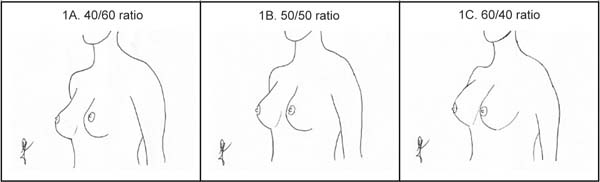
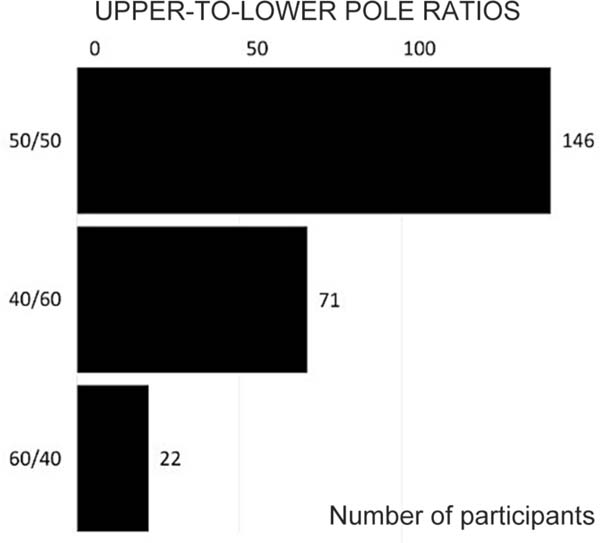
We analyzed the esthetic preference regarding breast proportionality, that is, the upper-to-lower pole volumetric ratios of 40/60 (► Fig. 1A), 50/50 (► Fig. 1B), and 60/40 (► Fig. 1C). Most (n ¼ 146; 61.1%) participants preferred the 50/50 ratio (► Fig. 1B). Seventy-one (29.7%) respondents preferred the 40/60 ratio (► Fig. 1A), and only 22 (9.2%) preferred the 60/40 ratio (► Fig. 1C). ► Fig. 2 shows these different preferences.

Different nipple-areola location
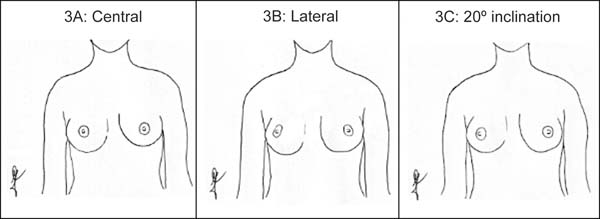
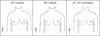
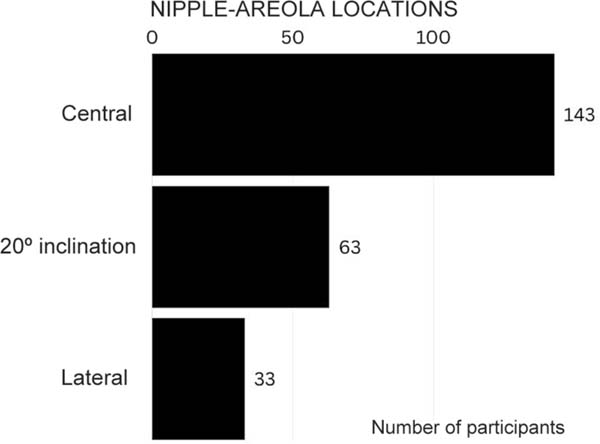
Regarding the preferred nipple-areola location, 143 (59.83%) participants selected a central site (► Fig. 3A); 33 (13.81%) selected the lateral location (► Fig. 3B). and 63 (26.36%) respondents preferred a 20° angled arrangement (► Fig. 3C). ► Fig. 4 depicts the preferred nipple-areola location in percentage.
Different nipple-areola ratio
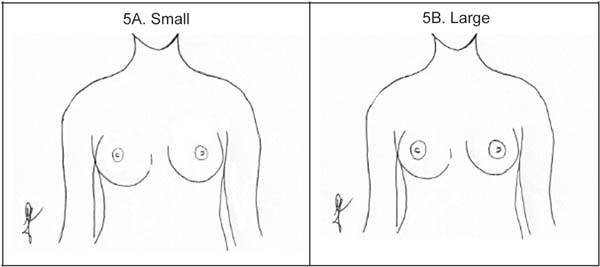
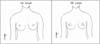
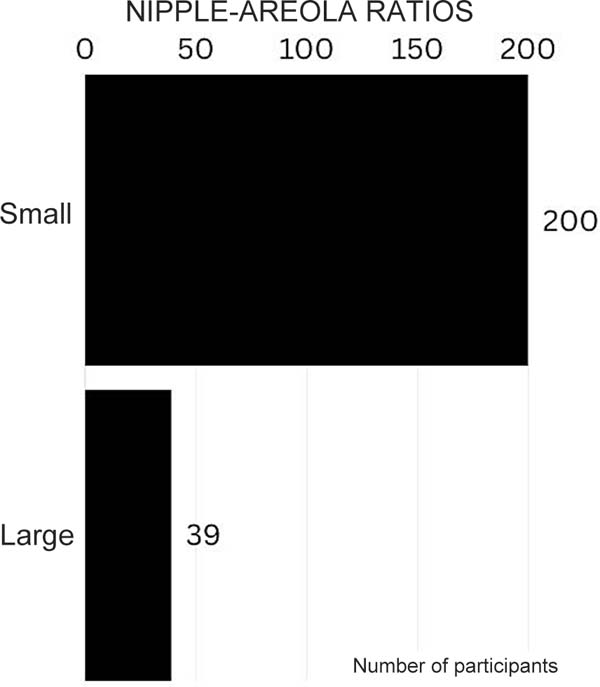
Regarding the size ratio between the areola and the nipple, most (n ¼ 200; 83.68%) participants preferred the image in ► Fig. 5A, which depicts a smaller areola and nipple. Thirty-nine (16.32%) respondents preferred a larger nipple-areola size (► Fig. 5B). ► Fig. 6 shows the different preferences regarding areola and nipple sizes.
Different preferences per gender
Female and male participants responded differently to the questionnaire. Women accounted for 72.38% (n ¼ 173) of the research sample, while men accounted for 27.62% (n ¼ 66). Regarding the upper-to-lower pole ratio, most women (n ¼ 109; 63.00%) preferred the 50/50 ratio (► Fig. 1B), followed by 50 (28.90%) who selected the 40/60 ratio (► Fig. 1A), and 14 (8.1%) who preferred the 60/40 ratio (► Fig. 1C). For the nipple-areola location, most (n ¼ 107; 61.85%) females preferred the central position (► Fig. 3A), followed by 44 (25.43%) who selected a 20° inclination (► Fig. 3C), and 22 (12.72%) who preferred the lateral position (► Fig. 3B). As for the nipple-areola ratio, most (n ¼ 148; 85.54%) respondents preferred the small size (► Fig. 5A) and 25 (14.45%) selected the large size (► Fig. 5B).
As for men, regarding the upper-to-lower pole ratio, 37 (56.1%) preferred the 50/50 ratio (► Fig. 1B), followed by 21 (31.8%) who opted for the 40/60 ratio (► Fig. 1A), and 8 (12.1%) who selected the 60/40 ratio (► Fig. 1C). For the nipple-areola location, 36 (approximately 54.50%) preferred the central position (► Fig. 3A), followed by 19 (28.80%) who selected a 20° inclination (► Fig. 3C), and 11 (16.70%) who opted for the lateral position (► Fig. 3B). Regarding the nipple-areola ratio preference, 52 (78.8%) men preferred the smaller size, and the remaining 14 (21.20%) selected the larger size.
Discussion
The present cross-sectional study, based on a questionnaire sent to the target population, identified several breast-related esthetic preferences. The single criterion standing out was the agreement among respondents. The authors emphasize that this research did not aim to define an esthetic standard, but rather to understand the esthetic perspective of the sample.
When analyzing esthetic preferences regarding breast proportionality, specifically the volume of the upper and lower poles, we observed that 63% of participants opted for the 50/50 ratio, rather than the 60/40 or 40/60 ratio. This percentage is consistent with another study.16 Such a majority choice aligns with the findings of Mallucci et al. on breast beauty definition, who stated that higher breast deviation reduces their attractiveness. Excessive upper and lower pole volumes are equally unattractive, and their deviation from the norm is very pronounced.1 Breasts that do not exhibit this pronounced measurement would be more attractive. In our research, 8.50% of respondents preferred the 60/40 ratio, consistent with a study by Jimenez et al., in which less than 8.60% of participants chose this ratio.16
We also inquired about differences in the areola and nipple locations. The visual characteristics of the nipple-areola complex included size, position, projection, vector, state of contraction, and symmetry with the opposite side.11 In our research, a significant portion (59.50%) of the participants preferred the central location. Other studies indicated that a nipple located at this limit of the upper and lower poles (nipple meridian) and pointing upwards (average angle of 20°) was visually pleasing.1,11 Another study also reported a preference for nipple-areola complexes with a central location.16 The nipple should ideally accentuate the apical projection of the breast.11
Regarding the areola-to-nipple ratio, a significant portion (83.50%) of the research participants opted for smaller areolas and nipples. While some opinions may differ, it is crucial to emphasize that plastic surgeons should carefully consider harmonious body proportions and not focus solely on breast size.11
The comparative assessment of esthetic preferences between females and males revealed no statistically significant differences. In this metric, preferences remained tied to proportionality, emphasizing that despite individual preference factors, the perception of beauty relies on proper sizes and anthropometric proportions, which support harmony.11
Most participants preferred the 50/50 ratio, with 109 (62.90%) females and 37 (56.10%) males choosing this option. In contrast, 50 (28.90%) females and 21 (31.80%) males selected the 40/60 ratio, while only 14 (8.10%) women and 8 (12.10%) men chose the 60/40 ratio. This pattern indicates a general preference for the 50/50 ratio across both genders, though there were slight variations in the choices made by males and females.
Regarding location, most women (n ¼ 107; 61.80%) selected the central option, as did 36 (54.50%) men. However, women showed greater diversity in their choices, with a considerable proportion opting for the inclined location (n ¼ 44; 25.40%). Only 11 (16.70%) men preferred the lateral position.
Regarding areola size, 148 (85.50%) women preferred a smaller areola; among men, the preference was more balanced, with 52 (78.80%) opting for the smaller areola and 14 (21.20%) for the larger areola. These data suggest that, while women preferred smaller areolas more clearly, men displayed a more balanced range of opinions, though the preference for smaller areolas still prevailed.
It is worth noting that, although the study sample was considerably imbalanced (173 women versus 66 men), the results offer important insights into the preference trends of both genders. Nevertheless, the limited representation of men may influence the generalizability of the findings to the male population.
Munhoz et al. underscored the importance of respecting the anatomical proportions and units of the breast cleavage to achieve natural, harmonious outcomes by standardizing fat grafting areas in hybrid augmentations, consistent with the esthetic preferences revealed in this research.17 Stümpfle et al. highlighted minimally invasive surgical techniques favoring natural outcomes and subtle scars, aspects valued in contemporary breast esthetics.18
Conclusion
The present study identified that esthetic preferences regarding breasts among medical students at a medical institution in Rio Grande do Sul, Brazil, are influenced by multiple factors, including gender, age, and possibly the academic environment. We observed a predominant appreciation for harmonious proportions, especially the 50/50 upper-to-lower pole ratio, the central location of the nipple-areola complex, and the reduced size of the areola and nipple. These aspects partially align with the standards described in the literature. There were no statistically significant differences between genders, indicating that women and men agree on the ideal breast esthetic. The data pointed out that medical training can shape a more technical and grounded esthetic perception, setting it apart from the norms widely promoted by popular media. The study suggests the need to prioritize surgical techniques to improve breast symmetry to meet the identified preferences. Future research with larger samples and longitudinal designs is recommended to confirm our findings and deepen the understanding of the factors influencing breast esthetic perception.
REFERENCES
1. Mallucci P, Branford OA. Shapes, Proportions, and Variations in Breast Aesthetic Ideals: The Definition of Breast Beauty, Analysis, and Surgical Practice. Clin Plast Surg 2015;42(04):451–464. Doi: 10.1016/j.cps.2015.06.012
2. Rhee SC, Woo KS, Kwon B. Biometric study of eyelid shape and dimensions of different races with references to beauty. Aesthetic Plast Surg 2012;36(05):1236–1245. Doi: 10.1007/s00266-0129937-7
3. Sinno HH, Markarian MK, Ibrahim AMS, Lin SJ. The ideal nasolabial angle in rhinoplasty: a preference analysis of the general population. Plast Reconstr Surg 2014;134(02):201–210. Doi: 10.1097/PRS.0000000000000385
4. Wong WW, Motakef S, Lin Y, Gupta SC. Redefining the Ideal Buttocks: A Population Analysis. Plast Reconstr Surg 2016;137 (06):1739–1747. Doi: 10.1097/PRS.0000000000002192
5. Freese J, Meland S. Seven tenths incorrect: heterogeneity and change in the waist-to-hip ratios of Playboy centerfold models and Miss America pageant winners. J Sex Res 2002;39(02): 133–138. Doi: 10.1080/00224490209552132
6. Pitanguy I. Mammaplastias. Rev Latinoam Cir Plast 1963;7:139
7. Bozola AR. Redução mamária com cicatriz curta em L. Plast Reconstr Surg 1990;85(05):728–738. Doi: 10.1097/00006534199005000-0001
8. Bozola AR. Mamoplastia Redutora: Técnicas Preferenciais. In: Goldwyn RM, ed. Mamoplastia Redutora. Boston: Little Brown; 1990:407–437
9. Bozola AR, Longato FM, Bozola AP. Análise geométrica da forma da beleza da mama e da forma de prótese baseado na proporção Phi: aplicação prática. Rev Bras Cir Plást 2011;26(01):94–103. Doi: 10.1590/S1983-51752011000100019
10. Pontes R. A technique of reduction mammaplasty. Br J Plast Surg 1973;26(04):365–370. Doi: 10.1016/s0007-1226(73)90042-8
11. Atiye B, Chahine F. Metrics of the Aesthetically Perfect Breast. Aesthetic Plast Surg 2018;42(05):1187–1194. Doi: 10.1007/s00266-018-1154-6
12. Sandberg LJ, Tønseth KA, Kloster-Jensen K, et al. An Aesthetic Factor Priority List of the Female Breast in Scandinavian Subjects. Plast Reconstr Surg Glob Open 2020;8(10):e3173. Doi: 10.1097/GOX.0000000000003173
13. Lee HJ, Ock JJ. An Ideal Female Breast Shape in Balance with the Body Proportions of Asians. Plast Reconstr Surg Glob Open 2019;7 (09):e2377. Doi: 10.1097/GOX.0000000000002377
14. Hamzan MI, Sulaiman WAW, Ismail NN. Bigger Bust No Longer on Trend: Malaysians Prefer Moderation in Ideal Female Breast Augmentation. Indian J Plast Surg 2021;54(03):321–326. Doi: 10.1055/s-0041-1734572
15. Wallner C, Dahlmann V, Montemurro P, et al. The Search for the Ideal Female Breast: A Nationally Representative United-States-Census Study. Aesthetic Plast Surg 2018;46(04):1567–1574. Doi: 10.1007/s00266-021-02753-y
16. Jimenez NM, Gómez ASP. Breast Aesthetic Preferences: Analysis of 1294 Surveys. Aesthetic Plast Surg 2021;45(05):2088–2093. Doi: 10.1007/s00266-021-02253-z
17. Munhoz AM, Maximiliano J, Neto AAM, et al. Zones for Fat Grafting in Hybrid Breast Augmentation: Standardization for Planning of Fat Grafting Based on Breast Cleavage Units. Plast Reconstr Surg 2022;150(04):782–795. Doi: 10.1097/PRS.0000000000009605
18. Stümpfle RL, Piccinini PS, Zanin EM. Muscle-Splitting Transaxillary Revision Breast Augmentation-A Single Surgeon’s Experience. Aesthetic Plast Surg 2021;45(05):2027–2033. Doi: 10.1007/s00266-021-02179-6
1. School of Medicine, Universidade de Passo Fundo, Passo Fundo, RS, Brazil
Financial Support
Address for correspondence Luís Gustavo Ramos Raupp Pereira, Escola de Medicina, Universidade de Passo Fundo, Rua Teixeira Soares 817, Centro, Passo Fundo, RS, 99010-080, Brazil (e-mail: luisgustavoraupp@gmail.com).
Article received: January 19, 2025.
Article accepted: August 26, 2025.
Conflict of interests The authors have no conflict of interests to declare.
 Read in Portuguese
 Read in English
 PDF PT
 Print
Print
 Send this article by email
 How to Cite
 Mendeley
 Pocket
 Facebook
 Twitter