




Case Report - Year 2026 - Volume 41Issue 1
Keystone Flap for Immediate Breast Reconstruction after Hygienic Mastectomy: Case Report
Retalho de Keystone para reconstrução mamária imediata pós-mastectomia higiênica: Relato de caso
Andre Luiz Monteiro dos Santos Marins1, ; Mateus Teixeira Alfenas1; Gabriel Tiago Ligório1; Júlia Cardoso Laluce2; Bruno Ferreira Guimarães Figueiredo1; Bruno Veloso De-Souza1
ABSTRACT
Introduction Radical surgical excision in patients with locally advanced breast cancer results in significant skin loss that cannot be corrected with primary closure. The use of myocutaneous flaps provides effective coverage for large defects but requires longer operative time and can increase morbidity, delaying adjuvant oncologic treatment. Locoregional reconstruction with flaps, such as the Keystone flap, by contrast, offers shorter surgical time, lower morbidity, and stable vascularization, with partial necrosis rates comparable to those ofmyocutaneous flaps. The Keystone flap is widely used and recognized for large defects of the trunk and extremities; however, its application in breast reconstruction remains poorly described in the literature. We therefore report this case, in which this technique was used for reconstruction following a hygienic mastectomy in a patient with locally advanced breast cancer.
Methods A hygienic mastectomy was performed, followed by reconstruction using the Keystone flap. Surgicalmarking was performed in a trapezoidal geometry to ensure adequate flap advancement, preserving blood supply from the intercostal and superior epigastric arteries.
Results The patient was discharged on the first postoperative day, reporting mild pain. Breast reconstruction with the Keystone flap resulted in primary closure with full flap viability, good healing, and no signs of necrosis or dehiscence.
Conclusion The Keystone flap proved to be an effective, safe, and reproducible alternative for breast reconstruction, providing adequate coverage, reduced operative time, and rapid recovery.
Keywords: surgical flaps; plastic surgery; plastic surgery procedures; breast neoplasms; mastectomy
RESUMO
Introdução A excisão cirúrgica radical em pacientes com carcinoma de mama localmente avançado resulta em ampla perda cutânea que não pode ser corrigida por fechamento primário. O uso de retalhos miocutâneos proporciona cobertura eficaz para grandes defeitos, mas demanda maior tempo cirúrgico e pode aumentar a morbidade, atrasando o tratamento oncológico adjuvante. A reconstrução locorregional com retalhos, como o retalho de Keystone, por outro lado, oferece menor tempo cirúrgico, menor morbidade e vascularização estável, com taxas de necrose parcial comparáveis às dos retalhos miocutâneos. O retalho de Keystone é amplamente utilizado e reconhecido para grandes defeitos em tronco e extremidades; no entanto, sua aplicação na reconstrução mamária ainda é pouco discutida na literatura especializada. Diante disso, relatamos o presente caso, utilizando essa técnica para reconstrução pós-mastectomia higiênica empaciente com tumor localmente avançado.
Métodos Foi realizada uma mastectomia higiênica, seguida de reconstrução com retalho de Keystone. Amarcação cirúrgica foi realizada comgeometria trapezoidal para garantir o avanço adequado do retalho, preservando a vascularização proveniente das artérias intercostais e epigástrica superior.
Resultados A paciente teve alta no primeiro dia pós-operatório, relatando dor leve. A reconstrução mamária com o retalho de Keystone apresentou fechamento primário com total viabilidade do retalho, boa cicatrização e ausência de sinais de necrose ou deiscência.
Conclusão O retalho de Keystone demonstrou ser uma alternativa eficaz, segura e reprodutível para reconstrução mamária, proporcionando cobertura adequada, redução do tempo cirúrgico e rápida recuperação.
Palavras-chave: retalhos cirúrgicos; cirurgia plástica; procedimentos de cirurgia plástica; neoplasias da mama; mastectomia
Introduction
Breast cancer is the most frequent malignant tumor among women worldwide and represents a major public health problem. In Brazil, excluding non-melanoma skin tumors, an estimated 73,610 new cases per year are expected for the 2023–2025 triennium, corresponding to an adjusted incidence rate of 41.89 cases per 100,000 women.1 Modern surgical approaches range from breast-conserving surgery (tumorectomy or lumpectomy) to mastectomy with complete axillary dissection.2 Despite surgical advances, reconstruction after extensive resections remains challenging. A broad spectrum of techniques is available, allowing complex resections and reconstructions in tumors involving breast tissue or chest wall structures, while preserving function, providing adequate coverage, and achieving tumor-free margins, which are crucial for reducing recurrence.3 Options range from local fasciocutaneous flaps and alloplastic materials to autologous and microsurgical flaps, and, in patients eligible for adjuvant radiotherapy, reconstruction with autologous tissue is often preferred.4
The Keystone flap is widely used and recognized for the reconstruction of large defects of the trunk and extremities; however, its application in breast reconstruction remains poorly described in the literature. It consists of a trapezoidal or elliptical fasciocutaneous flap adjacent to the defect, with viability depends on the preservation of musculocutaneous or fasciocutaneous perforating vessels, ensuring excellent vascularization even in irradiated areas or regions with impaired healing. The design involves lateral marking adjacent to the defect, with equivalent width, followed by flap elevation through blunt dissection while preserving the subcutaneous vascular plexus and perforating vessels. This arrangement allows flap advancement through V-Y advancement, uniformly distributing tension forces, facilitating primary closure of the donor site, and minimizing complications such as necrosis or dehiscence.5, 6
Given the advantages of the Keystone flap, including its reproducible technique, rapid recovery, and safety in extensive defects,5 this study reports its application in post-hygienic mastectomy reconstruction in a patient with a locally advanced tumor, contributing to the expansion of the surgical options available for breast reconstruction.
Case report
A 44-year-old female patient presented with a locally advanced left breast tumor after neoadjuvant chemotherapy. She reported the presence of a nodule for two years, with progressive growth during treatment. The diagnosis was invasive ductal carcinoma, staged as T4bN1M1 (►Fig. 1), with a Ki-67 index of 30% and evidence of tumor progression.
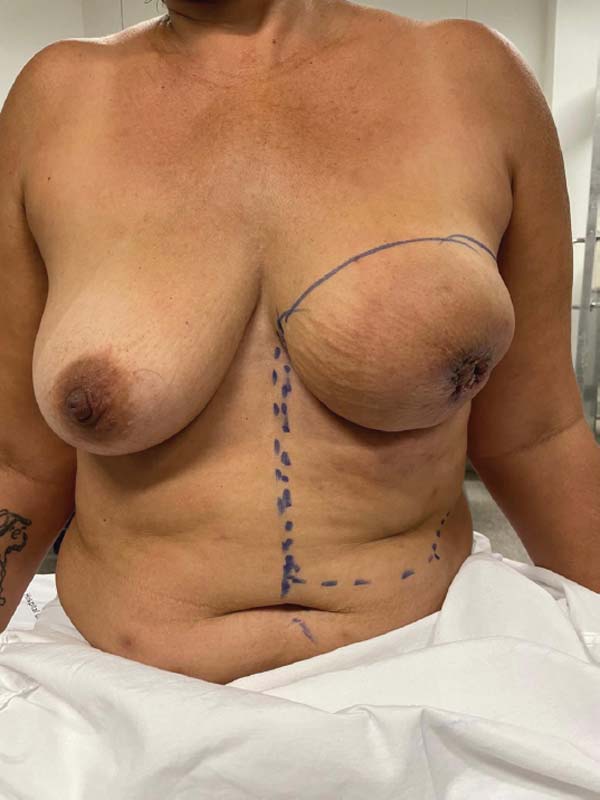
Physical examination revealed an ulcerated lesion measuring approximately 6 × 6 cm in the left breast (►Fig. 2), with confluent lymph nodes at levels II and III. Chest computed tomography demonstrated a retroareolar mass measuring 4.1 × 2.6 × 3.1 cm, diffuse skin thickening, axillary lymphadenopathy (1 cm), and multiple non-calcified pulmonary nodules, without bone lesions.
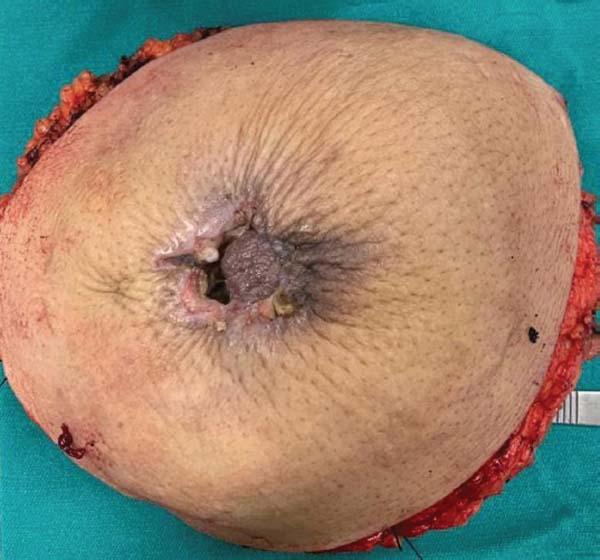
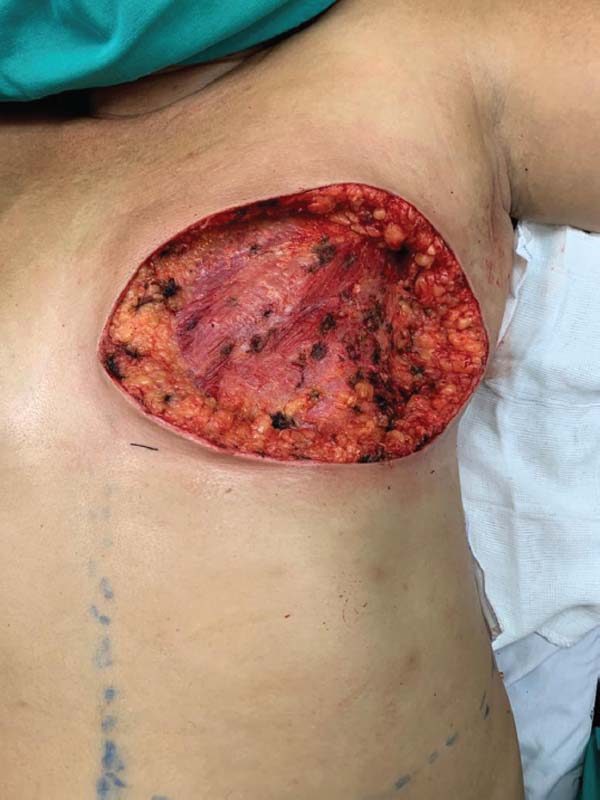
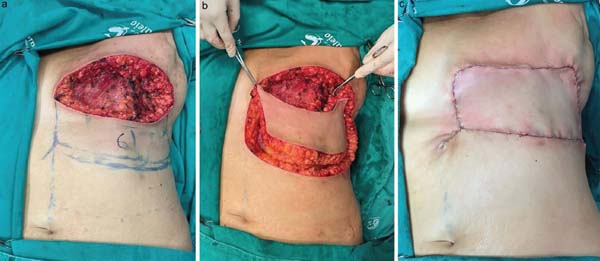
The patient underwent a left hygienic mastectomy (►Fig. 3), followed by reconstruction using a fasciocutaneous island flap with flap design, incision, and advancement as shown in ►Fig. 4a–c. Closure was performed in layers, with satisfactory tissue approximation.

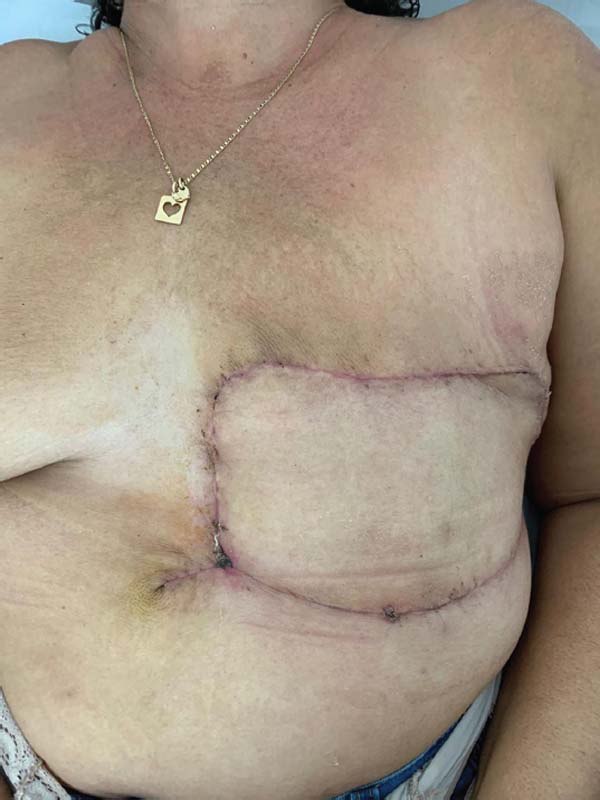
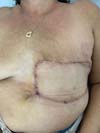
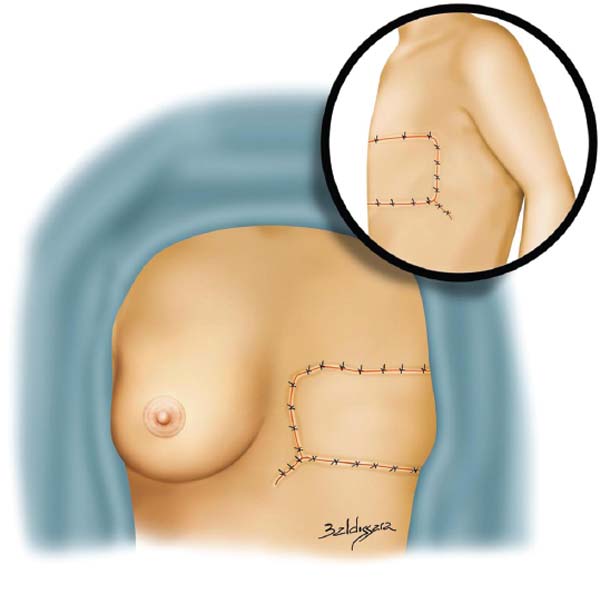
The patient had a favorable postoperative course, with mild pain (visual analog scale [VAS], 3), and was discharged on the first postoperative day. The drain was removed on the seventh day after serous drainage decreased to < 50 mL/day, and satisfactory healing was observed (►Fig. 5).
The case was approved by the Research Ethics Committee of Fundação Benjamin Guimarães – Hospital da Baleia (CAAE 83112524.6.0000.5123), and written informed consent was obtained from the patient.
Surgical Technique
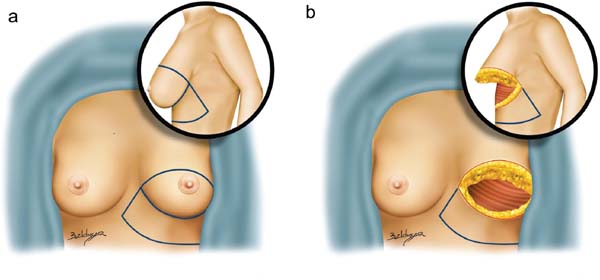
Surgical marking was initially performed (►Fig. 6a) after the mastology team had defined the excisional limits, with the flap designed in a 1:1 proportion relative to the defect size (►Fig. 6b).

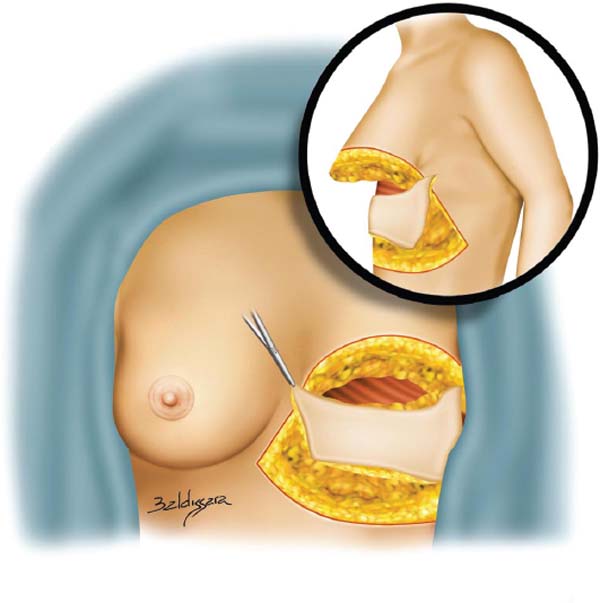
Subsequently, incision and advancement of the fasciocutaneous island (Keystone) flap were performed, with vascularization in the present case originating from the intercostal and superior epigastric arteries (►Fig. 7).
Closure was performed in layers, with compensatory adjustments in the angulated regions (►Fig. 8).
Discussion
Locally advanced breast carcinoma comprises stage III disease (IIIA, IIIB, and IIIC), including tumors > 5 cm (T3), tumors involving the chest wall (T4a), skin (T4b), or both (T4c), as well as extensive lymph node involvement (N2/N3) affecting one or more lymphatic chains and inflammatory carcinoma.7
Radical surgical excision in these patients results in extensive skin loss in the thoracic region that cannot be repaired with primary closure. The use of myocutaneous flaps provides effective coverage for large defects; however, these procedures require longer operative time, increasing morbidity and potentially delaying adjuvant oncologic treatment.7
Although myocutaneous flaps remain However, despite the well-established indication for myocutaneous flaps in chest wall reconstruction after mastectomy, the role of locoregional reconstruction has already been widely discussed in the literature. Its advantages include shorter operative time, lower morbidity, and stable vascularization, with rates of partial necrosis similar to those of myocutaneous fl aps.7, 8 For these reasons, the Keystone technique was selected in the present case.
In 2003, Behan et al.5 described the Keystone flap as a fasciocutaneous island flap whose trapezoidal geometry, with its longest axis parallel to the defect, ensures recruitment of perforating vessels adjacent to the wound, providing reliable vascularization.7, 8, 9 This design also allows tissue advancement with low donor-site morbidity, with closure at one extremity resembling a V-Y flap.10
Vascularization of the flap is proportional to the extent of the designed skin island, provided that the area of contact with the underlying fascia, through which the perforating vessels emerge, is preserved.5,10 In this way, the possibility of ischemia, necrosis, and chest wall destabilization is reduced.8, 9 In the present case, vascular supply originated from the intercostal and superior epigastric arteries.
These characteristics allow considerable versatility in the creation of Keystone flaps of varying sizes for a broad spectrum of reconstructions.8 The complication rate reported in the literature for the use of the Keystone flap is low, and in the present case no complications related to flap vascularization occurred.
Conclusion
The Keystone flap proved to be a satisfactory reconstructive option in this case. Description of this method is relevant, as it demonstrates that this alternative can provide adequate dermocutaneous coverage for the defect described, with reduced operative time and faster recovery. It is a safe, effective, and easily reproducible technique, representing a versatile resource in the armamentarium of the plastic surgeon involved in breast reconstruction.
References
1. Instituto Nacional de Câncer (Brasil) Controle do câncer de mama no Brasil: dados e números 2025. Rio de Janeiro: INCA; 2025. 85 p. Available from: https://ninho.inca.gov.br/jspui/handle/123456789/17733
2. Golara A, Kozłowski M, Lubikowski J, Cymbaluk-Płoska A. Types of breast cancer surgery and breast reconstruction. Cancers (Basel) 2024;16(18):3212. Doi: 10.3390/cancers16183212
3. Rocco N, Catanuto GF, Accardo G, et al. Implants versus autologous tissue flaps for breast reconstruction following mastectomy. Cochrane Database Syst Rev 2024;10(10):CD013821. Doi: 10.1002/14651858.CD013821.pub2
4. Mohan AT, Rammos CK, Akhavan AA, et al. Evolving concepts of keystone perforator island flaps (KPIF): principles of perforator anatomy, design modifications, and extended clinical applications. Plast Reconstr Surg 2016;137(06):1909–1920. Doi: 10.1097/PRS.0000000000002228
5. Behan FC. The Keystone Design Perforator Island Flap in reconstructive surgery. ANZ J Surg 2003;73(03):112–120. Doi: 10.1046/j.1445-2197.2003.02638.x
6. Riccio CA, Chang J, Henderson JT, et al. Keystone flaps: physiology, types, and clinical applications. Ann Plast Surg 2019;83(02): 226–231
7. Fontinele DRS, Araújo ALN, Valença RJV, Vieira SC. Retalho toracoabdominal para reconstrução de tumor de mama localmente avançado, em paciente com mutação de BRCA1. Rev Bras Cir Plást 2019;34(04):571–575
8. Ribeiro RDA, Pagotto VPF, Clivatti GM, Takahashi GG, Busnardo FF, Gemperli R. A versatilidade e confiabilidade do retalho Keystone em reconstruções oncológicas. Rev Bras Cir Plást 2022;37(03):308–312
9. Gómez OJ, Barón OI, Peñarredonda ML. Keystone Flap: Overcoming Paradigms. Plast Reconstr Surg Glob Open 2019;7(03):e2126. Doi: 10.1097/G0X.0000000000002126
10. Shayan R, Behan FC. Re: the ‘keystone concept’: time for some science. ANZ J Surg 2013;83(7-8):499-500. Doi: 10.1111/ans.12303
1. Fundação Benjamin Guimarães, Hospital da Baleia, Cirurgia Plástica, Belo Horizonte,
Minas Gerais, Brasil
2. Universidade de Mogi das Cruzes, Faculdade de Medicina, Mogi das Cruzes, São Paulo,
Brasil
Address for correspondence André Luiz Monteiro dos Santos Marins, Rua Carolina Figueiredo, 62. Apto 403. Bairro Serra. Belo Horizonte – MG, Brazil, CEP: 3022-0130 (e-mail: dr.andremarins@gmail.com).
Article received: November 11, 2025.
Article accepted: April 10, 2026.
The authors declare no conflicts of interest.
Editor-in-chief: Dov Charles Goldenberg.
 Read in Portuguese
 Read in English
 PDF PT
 Print
 Send this article by email
 How to Cite
 Mendeley
 Pocket
 Facebook
 Twitter